SMART OUTFALL | October 2026 | V1.0
How should combined-sewer outfalls be retrofitted? ZhiLaiZhang Smart Flap Gate addresses three problems at once - overflow, backflow and flooding - from six common defects in riverside interception to five acceptance criteria for outfall devices.
"Interception and drainage without compromise; stop backflow and protect influent concentration."
Smart Outfall System Device (smart flap gate), by HIGHDE Intelligent (Guangdong) Technology Co., Ltd. Author: Ji Qian.
Part 01 | Six common defects in riverside interception
The last few metres of an urban drainage system are often the most expensive lesson. Riverside interception pipes have been rebuilt several times; budgets are spent and pipes laid, yet rivers still turn black in rain and manholes still seep sewage in dry weather. The problem is usually not whether it was built, but how - especially whether those final metres were built correctly. This single exchange window between the drainage system and the river determines three outcomes at once: black-odorous water, treatment plant efficiency and urban flood safety.
- 1. One diameter for the whole trunk. The interception volume was never calculated; the pipe runs full even in dry weather, leaving no capacity for rain, so combined sewage and sediment go straight into the river.
- 2. Interception ratio wrong at both ends. Too low and light rain causes overflow; too high and rainwater floods the treatment plant, diluting influent concentration and causingponding. Worse, branch ratios can exceed the trunk's capacity, forcing flow back out of manholes.
- 3. Interception wells in series. Sewage collected upstream is diluted again by downstream rainwater, so even a well-built upstream separation scheme fails downstream.
- 4. Leaking chambers. Corroded riverside manholes let sewage seep into the river in dry weather and river water back into the pipe in rain.
- 5. Pipes laid directly in the river. Zero separation from river water; a single break lets sewage and river water swap places.
- 6. No backflow protection at outfalls. Every riverside outfall is at risk; when the river rises, water pushes back into the interception pipe, raises the trunk level and causes overflow.
"An outfall without backflow protection is the physical exit for every other defect." The first five stop the right water being intercepted; the sixth delivers it straight into the river. Note for separated areas: dry-weather misconnections can contribute around 20% of total sewage to stormwater pipes - from balcony washing machines, car washing and street cleaning - so stormwater systems also need interception backup.
Part 02 | Five acceptance criteria for a good outfall
Some design institutes have proposed an "ideal sewage interception system" model with five characteristics that work directly as acceptance criteria:
- Parallel interception - collected sewage is not repeatedly diluted by rainwater picked up along the route
- Controllable interception at the design value - no over-capture, keeping the trunk gravity-fed, unpressurised and at steady velocity
- Prevention of river backflow
- Prevention of reverse flow from the trunk into the intercepted pipe
- Weir height and width that also accommodate flood discharge
Checking existing interception wells against these five item by item usually reveals the root cause immediately.
Part 03 | Setting the interception ratio
Chinese codes give a reference interception ratio of 2 to 5. The value depends on four factors: local rainfall characteristics, remaining capacity of the network and treatment plant, whether first-flush runoff is collected, and the stage of district development. A more robust approach works backwards from the water body's environmental capacity: pollutants carried by overflow must not exceed what the water can absorb, and the interception volume is cross-validated by drainage system tests, historical data and model calculations. Hard rule: a branch's interception ratio must not exceed the trunk's; if it must, add buffer storage rather than forcing the trunk to cope.
Part 04 | Solution: ZhiLaiZhang makes backflow prevention and flood discharge one action
Conventional interception wells are broadly weir, trough or combined types. Weirs create a fixed sediment point opposite the interception pipe; troughs suffer from drop impact, aerated flow and head loss; combined types are trough-dominated below a 1.2 weir/trough ratio and weir-dominated above 1.4. But the real weakness is not the type - it is the lack of control: once the water level rises, actual interception far exceeds the design value and the trunk is forced to run under pressure.
Retrofit option 1: flow-limiting valves. Vortex limiters use tangential flow and aeration to dissipate energy, with manufacturer-calibrated, clearly defined characteristic curves. For DN80, DN100 and DN150, maximum gravity-flow discharge is 1.77, 3.72 and 7.80 L/s respectively, and 4.5, 7.5 and 12.0 L/s in the limiting stage - so selection can be made directly from the design requirement.
Retrofit option 2: automatic control. The common choice here is a hydraulic gate: the plate drops to seal the outfall against river backflow and is lifted hydraulically for flood discharge. The principle is sound, but at small, scattered outfalls the cost is considerable.
"There is one unavoidable test for an outfall device: can it still open when the power fails?" Every hydraulic gate cycle depends on hydraulic pressure to lift the plate, requiring three-phase power, a hydraulic station, oil pump, accumulator, piping and valve group, plus space beside the well for the pump set. That brings a chain of practical problems: continuous power draw to hold pressure; many failure points in hoses, valves and seals; loss of lifting force on power failure exactly when flood discharge is most needed; and high maintenance demands for oil, filters and seals that routine inspection crews cannot handle.
"Hydraulic gates solve automatic control, but at small, scattered outfalls they make a simple job complicated."
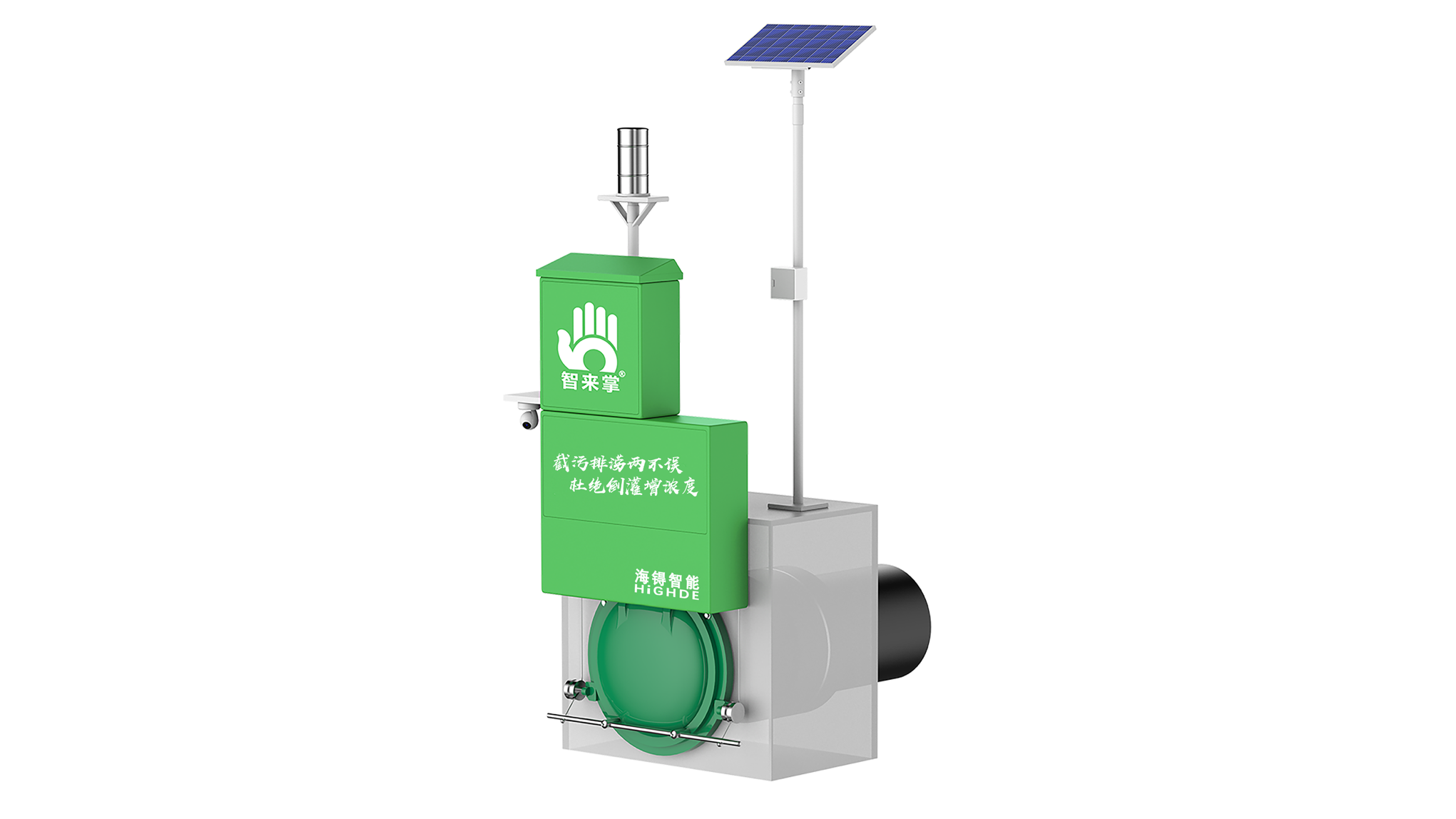
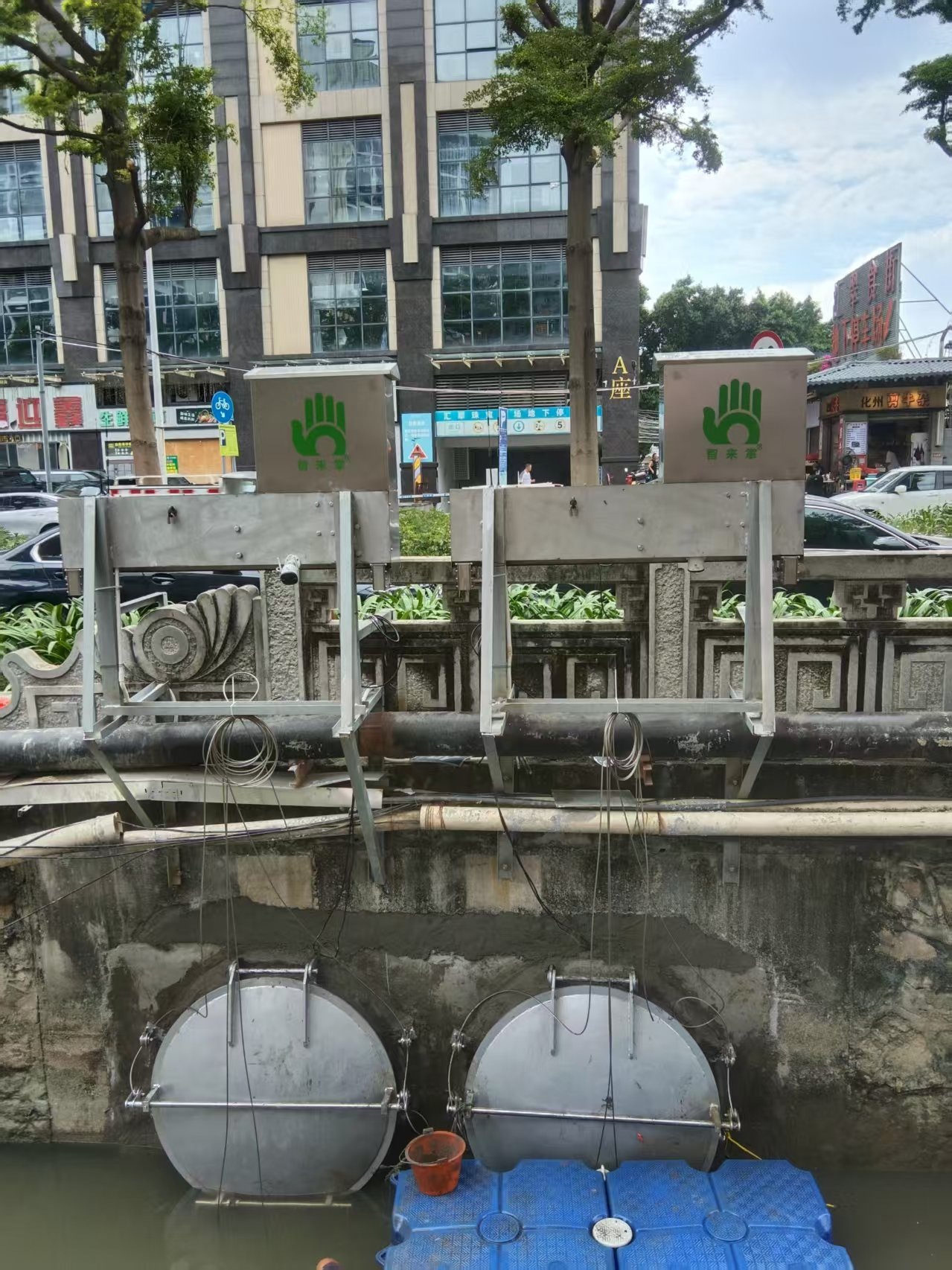
The Smart Outfall System Device (smart flap gate), internally named ZhiLaiZhang, takes a different route: mechatronics plus automatic control, with power-off flood discharge as the default behaviour rather than an optional extra. The key difference is the default direction at the moment power is lost. A hydraulic gate cannot lift its plate, so its default is closed; ZhiLaiZhang's mechanism falls back and the gravity flap opens, so its default is open. One locks itself shut when discharge is most needed; the other releases automatically. That is what we mean by power-off flood discharge.
The device holds 3 patents and 3 software copyrights, has passed multiple test reports, and more than 1,000 units are running continuously online across the Pearl River Delta.
Case 01 | Power-off discharge
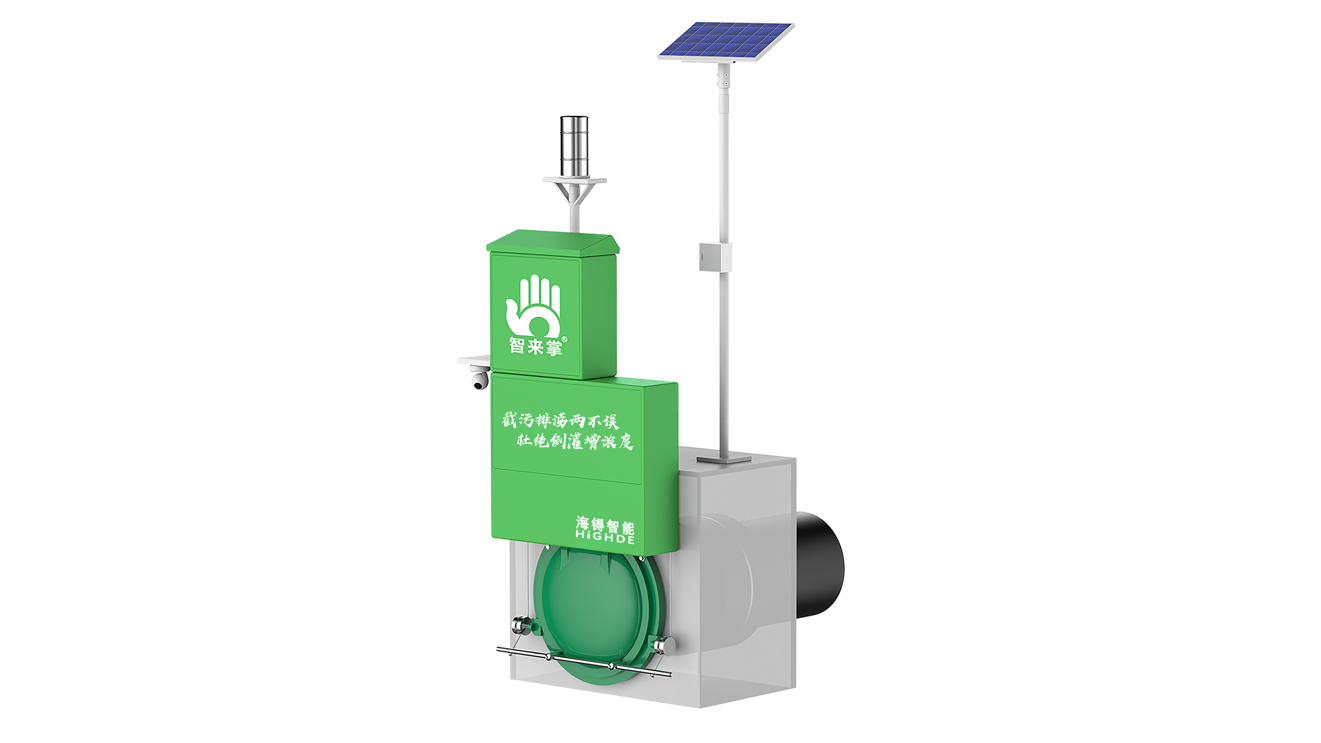
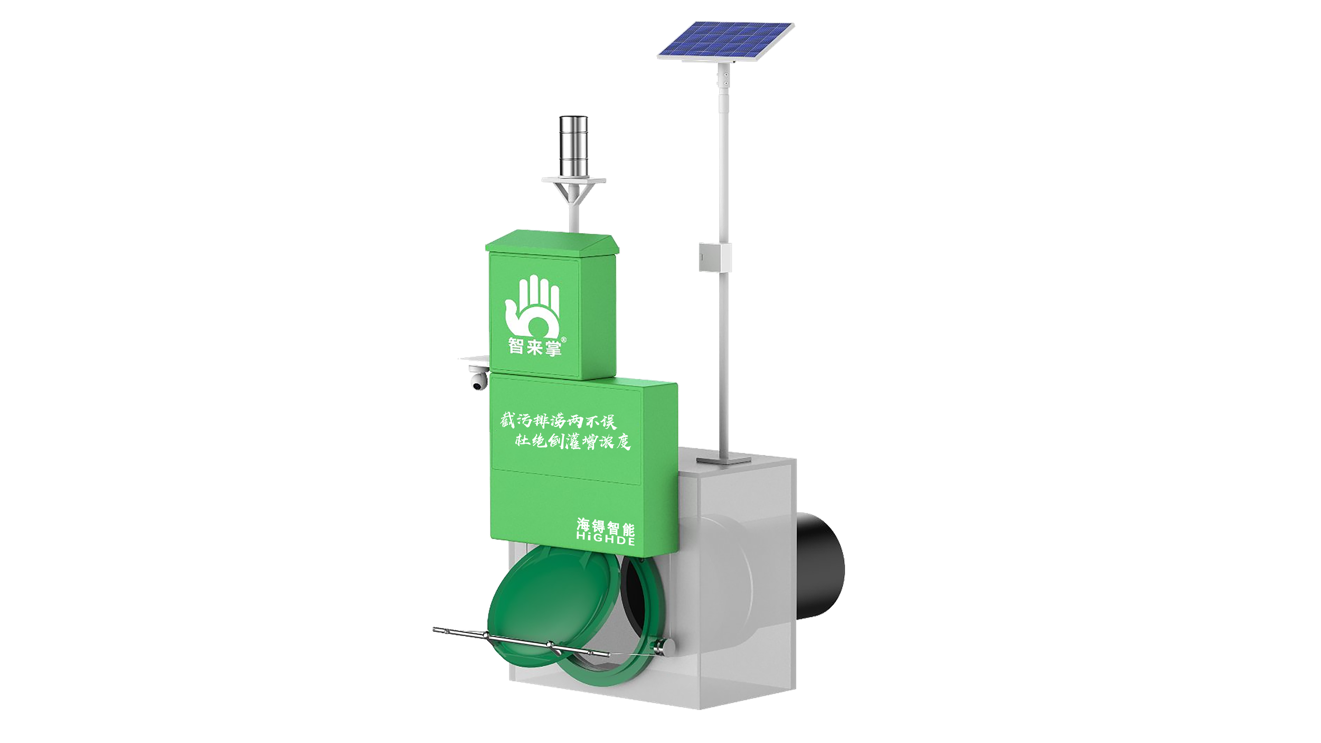
On power loss, network loss or pipe overpressure, the device opens automatically for flood discharge after a preset delay; with no power the mechanism falls back and the original gravity flap function is restored - a patented design point. Closed, the flap seals the opening against river backflow; open, it swings clear and the outfall regains full flow capacity. Under high-water immersion the device opens in seconds, compared with roughly 8 minutes for the fastest electric gate - long enough for a short, intense storm to flood low-lying roads.
Case 02 | Sealing to 2-3 times the pipe diameter in head difference
A flexible multi-point force-distribution structure replaces the single-point loading of a conventional flap gate, spreading water pressure evenly and tightening the seal. The reinforced version withstands a head difference of 2-3 times the outfall diameter.
Case 03 | Low power: single-phase 220 V, 400 W
Average annual electricity cost is under RMB 300 - negligible against the overflow pollution and flood damage it prevents. Drive components have passed 30,000 hours of operation with no wear.
Case 04 | Four-remote control with dual level monitoring
Dual level monitoring inside and outside the pipe, plus online video, provides remote signalling, measurement, control and adjustment, with customisable opening angles. Dual levels feed a data model that calculates overflow and backflow volumes. The device supports Modbus and OPC for connection to government supervision platforms. Sizes cover DN200 to DN2000, round or rectangular, with IP65 protection and an operating range of -25 C to +85 C.
Case 05 | Trenchless retrofit at the existing flap gate
The device is fitted at the existing flap gate position without excavation or disturbance to the main pipeline structure, at roughly 65% lower cost than an intelligent diversion well. Routine on-site inspection is needed only once every two weeks, supported by 24/7 AI online inspection - shifting from dispersed manual checks to digital O&M.
Case 06 | River outfall remediation in a built-up Pearl River Delta district
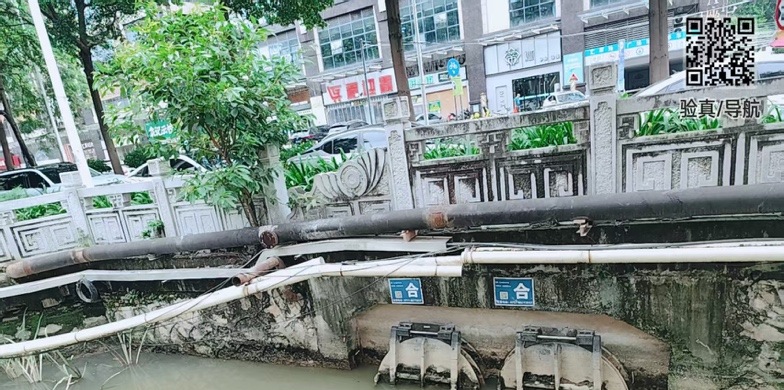
The site originally used a gravity flap gate plus overflow weir. The ageing gate had deformed and failed, so dry-weather sewage overflowed into the river; rising river levels pushed back into the network, diluting treatment plant influent; and the weir restricted flow capacity, worsening flood risk. No lifting or excavation was possible on site, so the crew transported equipment on a floating platform and worked during low-tide windows - anchoring, sealing the base and sealing inside the pipe at night - without disturbing the network or significantly affecting traffic and residents. Afterwards the outfall sealed tightly in dry weather and discharged automatically by level in rain; backflow was blocked and influent concentration was protected. Completed July 2026.
Part 05 | Four device types, four outcomes
- Smart flap gate (ZhiLaiZhang) - integrated mechatronics, automation, information and digital O&M; automatically discharges floodwater on power loss
- Hydraulic gate - single-rod point loading, three-phase supply and continuous hydraulic pressure; cannot lift the plate on power loss
- Gravity flap gate - no powered control; ages, then overflows and admits backflow
- Electric gate - slow to open; cannot open on power loss or overpressure, risking flooding
The four differ fundamentally in structure, power-off discharge capability, energy use and digital O&M, and should be distinguished during selection.
Part 06 | Five layout rules for the final metres
- Independent, controllable interception wells - both outlet and outfall must be controllable and protected against backflow; keep river water and sewage apart inside the well
- Set the trunk back from the river blue line - reduce the risk of sewage/river water exchange by distance first
- Minimise river crossings - avoid them where possible; where unavoidable, consolidate crossings, use high-quality pipe and place no manholes in the river
- No large interception-and-discharge schemes - do not simply block outfalls to collect more, or cut openings into the interception trunk for drainage
- Place interception facilities near the source - at building misconnection risers, combined outfalls inside the site boundary, and trunk/intersection points; the closer to the source, the smaller the impact downstream
Part 07 | Three metrics to verify performance
Classify rainfall events by 12-hour depth (light, moderate, heavy, storm) and score only independent events separated by more than 24 hours. Track: (1) overflow frequency; (2) overflow volume control rate; (3) overflow pollutant load reduction rate. This is not a build-and-forget project - long-term online monitoring plus mathematical modelling is what enables dynamic control and precise interception.
"Get the outfall right, and black-odorous water control, treatment efficiency and flood safety finally add up on the same balance sheet."
FAQ
Q1. If power fails and the gate cannot open, will it flood? No. On power loss, network loss or overpressure it opens automatically after a preset delay; without power the mechanism falls back to the original gravity flap function.
Q2. How is sealing ensured? A flexible multi-point force-distribution structure spreads pressure evenly; the reinforced version withstands a head difference of 2-3 times the outfall diameter.
Q3. Can old outfalls be retrofitted, and is excavation needed? Yes. The device fits at the existing flap gate position without excavation or disturbance to the main pipe structure.
Q4. How is O&M arranged? Dual level monitoring, online video and four-remote control, with on-site inspection once every two weeks and 24/7 AI online inspection.
Q5. What does a unit cost? It depends on outfall diameter, materials, monitoring and platform scope, and site conditions; trenchless retrofitting costs about 65% less than an intelligent diversion well.
Q6. What is the opening angle? Any angle from 0 to 150 degrees, set via the backend system.
Q7. Can it run automatically? Yes - via built-in level sensors, custom setpoints from backend analytics, or manual override, enabling a site-specific strategy for each outfall.
Q8. Can multiple users control it? Yes, the platform authorises multiple users with individually configured permissions.
Q9. Can it integrate with smart city or smart water platforms? Yes, seamlessly through a JSON-based API.
Reply "solution" for the four-option comparison table and key parameter quick-reference sheet. Water utilities are welcome to arrange a site visit to a benchmark river project in the Pearl River Delta.